Category: Statistics
-
The Intuition Behind Double ML
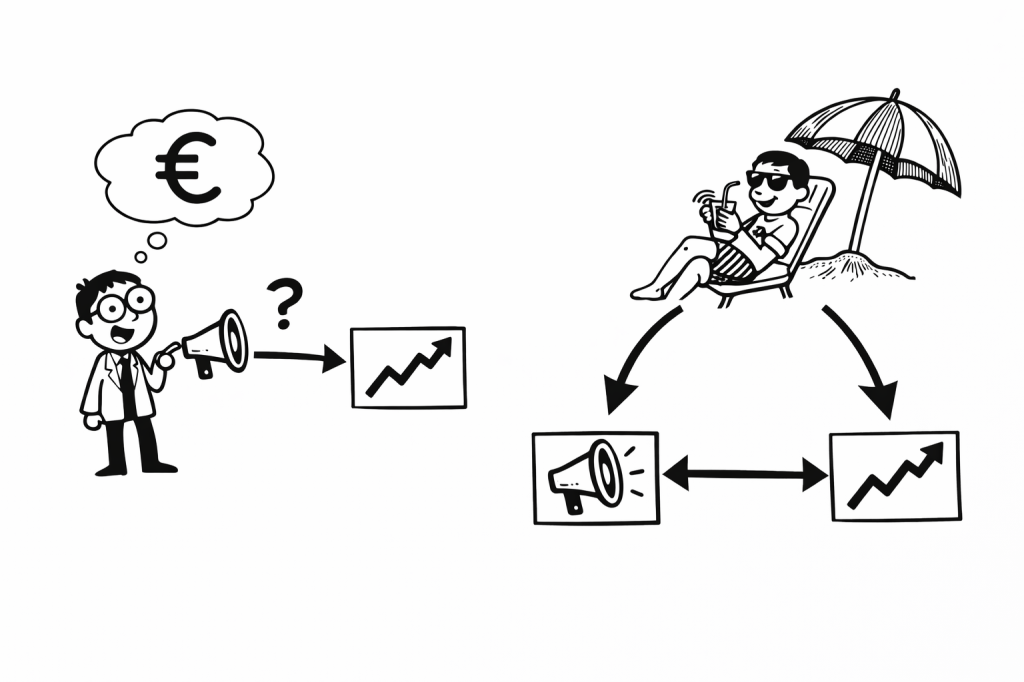
Double Machine Learning (DML or DoubleML) is one of the most powerful, modern techniques in data science & machine learning. However, I often find treatments of the subject a little convoluted, with writers reaching for math or using very particular domain vocabulary. In this article I’m going to drop the math, avoid all the jargon…
-
Bayesian Time Series Interpolation

The third article in the series, I explore Bayesian modeling for multivariate time series interpolation with hierarchical models with Numpyro and Bambi.
-
Expectation of a Gaussian Likelihood Function

This article explores the calculation of the expected likelihood of the Gaussian function rather than its maximum. It includes deriving the expectation of the Gaussian likelihood function, and the expectation of the likelihood of one Gaussian given the parameters of another Gaussian.
-
How to Choose a Distribution for your Regression Model
This article is all about distributions! In it, I explore the most common distributions including Gaussian, Uniform, Student-T, Gamma, and others. I also discuss their applications and when to choose them for regression modelling.
-
Stochastic Time Delay in Regression Analysis

I revisit a previous article on designing a regression model for stochastic time delay problems, where input-output delays vary randomly. The proposed model treats time delay components as part of the analysis, achieving improved results over standard regression methods in simulated experiments. Potential applications include marketing and medical settings. Future extensions might tackle multiple regression…
-
Multivariate Time Series Interpolation

The post describes a method to deal with sparse time series data using a Hierarchical Model and linear basis functions. The model learns the relationship between related series and movements over time, facilitating data interpolation even with minimal individual data points.
-
Bayesian Regression from Scratch
The post provides an in-depth explanation on how to understand Bayesian methods through building regression models from scratch. This includes generating sample data, explaining the Bayesian rule and Maximum Likelihood, describing Metropolis-Hastings algorithm, fits and uncertainties. The tutorial ends with performing Bayesian inference. The post acts as a hands-on guide to understand Bayesian modelling.
-
Heteroscedastic Data – Part 2: Inference

In this article, I deal with complex heteroscedastic problems for data analysis and inference. With a simulated dataset to demonstrate, I tackle issues such as strong trends, non-linearity, non-normal target distributions, multiple seasonalities, and changing variance. I use the advanced techniques of Bayesian Spline Modelling and Bayesian Additive Regression Trees (BART), emphasizing their efficacy in…
-
Heteroscedastic Regression
In this article, I deal with complex heteroscedastic problems for data analysis and inference. With a simulated dataset to demonstrate, I tackle issues such as strong trends, non-linearity, non-normal target distributions, multiple seasonalities, and changing variance. I use the advanced techniques of Bayesian Spline Modelling and Bayesian Additive Regression Trees (BART), emphasizing their efficacy in…
-
Mutual Information: a powerful alternative to correlation

While Pearson Correlation is effective in identifying relationships during exploratory data analysis, Mutual Information (MI) offers a powerful alternative, capable of uncovering non-linear relationships between variables. Despite being harder to interpret, its implementation in Scikitlearn is worth exploring.
-
Mutual Information
While Pearson Correlation is effective in identifying relationships during exploratory data analysis, Mutual Information (MI) offers a powerful alternative, capable of uncovering non-linear relationships between variables. Despite being harder to interpret, its implementation in Scikitlearn is worth exploring.
 Aaron Pickering