-
The Intuition Behind Double ML
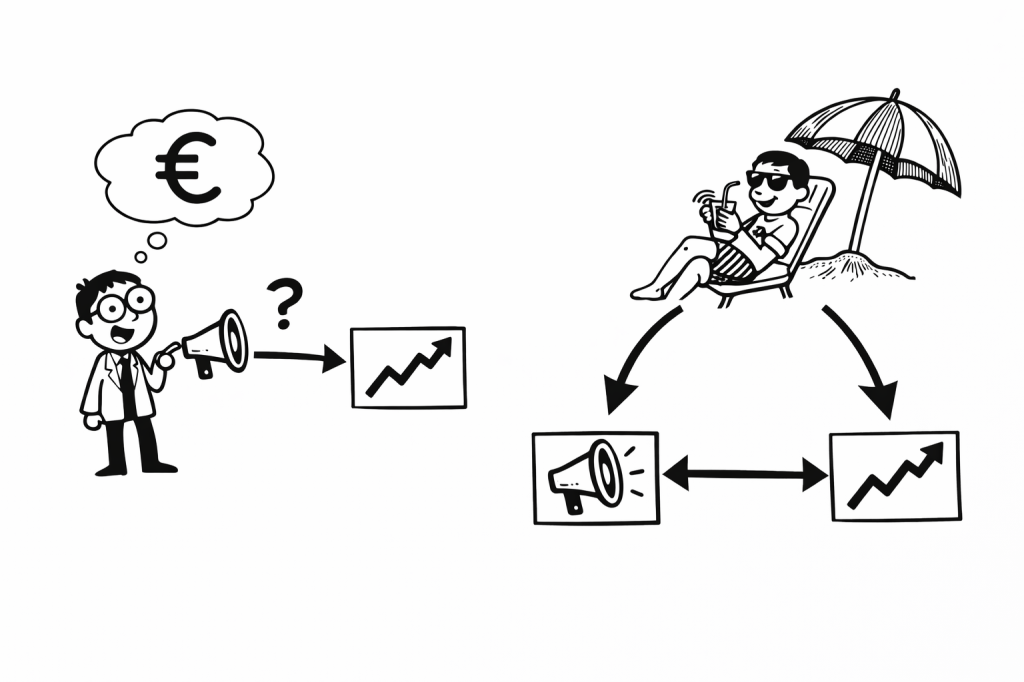
Double Machine Learning (DML or DoubleML) is one of the most powerful, modern techniques in data science & machine learning. However, I often find treatments of the subject a little convoluted, with writers reaching for math or using very particular domain vocabulary. In this article I’m going to drop the math, avoid all the jargon…
-
The Rise of AI Foundation Models

One surprising development, at least to me, in AI is the growing proliferation of foundational models. Text? Sure, makes sense. There’s lots of data out there. Then images, audio, video somehow seemed a natural continuation. But now time series, tabular data, geospatial data, graphs? Foundation models built on public and synthetic data are producing workable…
-
Stimmt So & German Practice

This month marks 10 years in Germany for me. It’s a big milestone! But, after all this time my German is still cringe. I’m in this real weird zone where I can understand fine, I can hold a conversation, but I make a grammar mistake about twice a sentence. I’m like a toddler with a…
-
Sketulate: Sketchable Functions & Densities for Data Science

I simulate a lot of data to test my ideas, particularly the more complex ones. With non-standard stuff, it can be pretty time consuming to find the right function and/or parameters to do what I want. If the shape you want isn’t a common function or distribution, you can spend too much time searching for…
-
Calibration Plots with Generalized Additive Models (GAMs)

Calibration of probabilistic predictions is a crucial task in many machine learning applications, especially when the outputs are used downstream for decision-making. It’s actually a simple concept, with calibration just ensuring that the predicted probabilities align with the actual outcomes. Despite that, I’ve noticed many people neglect the step in their modelling process! Typically, when…
-
XGBoost Can’t Extrapolate

A common pattern I observe among inexperienced Data Scientists is the following: they often default to XGBoost or a similar Gradient Boosted Model for their problem without considering whether it’s the right choice for the job. Given how powerful these methods are, this isn’t the most egregious mistake one can make. However, it’s important to…
-
Learn How to Containerize Your R Notebooks with Docker

In this article I show how to containerize your R Notebooks with Docker, for reproducible sharing, using renv for dependency management.
-
Small Data: Creativity, Explainability & Precision

This post discusses the significance of small data in the context of data science and modeling, detailing tips and tricks for working with small data sets.
-
Bayesian Time Series Interpolation

The third article in the series, I explore Bayesian modeling for multivariate time series interpolation with hierarchical models with Numpyro and Bambi.
-
Interrupted Time Series

When experimenting with something new, everyone has an opinion! Thats why it’s especially important to gather empirical evidence, to truly measure success. In this series of articles, I will explore a variety of techniques for experimentation, measurement and the gathering of evidence. Today’s article concerns one such fundamental technique – Interrupted Time Series analysis. The…
-
Genetic Algorithms with PyGAD and PyTorch
Deep dive into Genetic Algorithms (GAs), an optimization algorithm inspired by the concept of natural evolution, including using a GA to train a Pytorch model with the Pygad library.
-
Expectation of a Gaussian Likelihood Function

This article explores the calculation of the expected likelihood of the Gaussian function rather than its maximum. It includes deriving the expectation of the Gaussian likelihood function, and the expectation of the likelihood of one Gaussian given the parameters of another Gaussian.
-
How to Choose a Distribution for your Regression Model

This article is all about distributions! In it, I explore the most common distributions including Gaussian, Uniform, Student-T, Gamma, and others. I also discuss their applications and when to choose them for regression modelling.
-
Stochastic Time Delay in Regression Analysis

I revisit a previous article on designing a regression model for stochastic time delay problems, where input-output delays vary randomly. The proposed model treats time delay components as part of the analysis, achieving improved results over standard regression methods in simulated experiments. Potential applications include marketing and medical settings. Future extensions might tackle multiple regression…
-
Time Series Interpolation using Embeddings & Pytorch

In this article, I use categorical embeddings to tackle time series data interpolation. An algorithmic approach is introduced using Pytorch and I discuss the benefits and drawbacks. Eventually, the creation of a model with these components is demonstrated, as well as the strengths and weaknesses compared to other statistical approaches.
-
Multivariate Time Series Interpolation

The post describes a method to deal with sparse time series data using a Hierarchical Model and linear basis functions. The model learns the relationship between related series and movements over time, facilitating data interpolation even with minimal individual data points.
-
A/B and C (Multivariate) Tests with PyMC

The blog post provides a guide to using PyMC for Bayesian A/B/C tests, using a Bernoulli likelihood and the panel regression style. The post explores generating data samples, adopting a Bernoulli model approach, using Bambi to simplify the model setup, and interpreting results.
-
Bayesian Regression from Scratch
The post provides an in-depth explanation on how to understand Bayesian methods through building regression models from scratch. This includes generating sample data, explaining the Bayesian rule and Maximum Likelihood, describing Metropolis-Hastings algorithm, fits and uncertainties. The tutorial ends with performing Bayesian inference. The post acts as a hands-on guide to understand Bayesian modelling.
-
Heteroscedastic Regression

In this article, I deal with complex heteroscedastic problems for data analysis and inference. With a simulated dataset to demonstrate, I tackle issues such as strong trends, non-linearity, non-normal target distributions, multiple seasonalities, and changing variance. I use the advanced techniques of Bayesian Spline Modelling and Bayesian Additive Regression Trees (BART), emphasizing their efficacy in…
-
Heteroscedastic Data – Part 2: Inference
In this article, I deal with complex heteroscedastic problems for data analysis and inference. With a simulated dataset to demonstrate, I tackle issues such as strong trends, non-linearity, non-normal target distributions, multiple seasonalities, and changing variance. I use the advanced techniques of Bayesian Spline Modelling and Bayesian Additive Regression Trees (BART), emphasizing their efficacy in…
-
Mutual Information

While Pearson Correlation is effective in identifying relationships during exploratory data analysis, Mutual Information (MI) offers a powerful alternative, capable of uncovering non-linear relationships between variables. Despite being harder to interpret, its implementation in Scikitlearn is worth exploring.
-
Mutual Information: a powerful alternative to correlation
While Pearson Correlation is effective in identifying relationships during exploratory data analysis, Mutual Information (MI) offers a powerful alternative, capable of uncovering non-linear relationships between variables. Despite being harder to interpret, its implementation in Scikitlearn is worth exploring.
-
Working with Heteroscedastic Data

Heteroscedasticity, variance inconsistency across a related variable’s range, is often overlooked in data analysis. The two-part series explores handling heteroscedastic data through transformations, linear models, and model-based solutions, using LinkedIn engagements for instance. Techniques include Quantile Regression, Conditional Variance model, and common transformations like power or square root transformations.
-
Hierarchical (Multilevel) Modelling

Hierarchical modeling is a powerful statistical technique to analyze nested or grouped data. It considers both global structure and individual characteristics, delivering more accurate and robust estimates. Hierarchical models outperform traditional machine learning models, providing lower error rates and better handle outliers, especially with small datasets.
-
Introduction to Exponential Smoothing
This article intros the enduring Exponential Smoothing (ETS) in time series forecasting despite. I explore 4 key ETS variants, their formulas, and practical applications. Additionally, it touches on auto parameter selection for ETS models.
-
Subscribe
Subscribed
Already have a WordPress.com account? Log in now.
 Aaron Pickering